
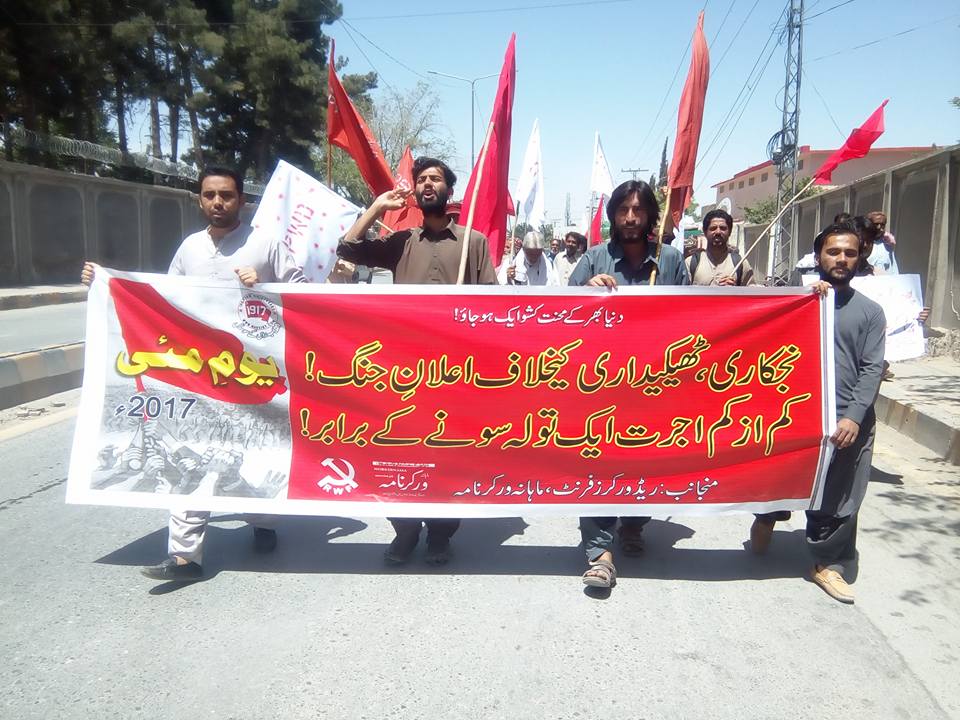
The Pakistan Trade Union Solidarity (PTUS) Campaign is an international solidarity campaign set-up to connect Pakistani youth, workers and trade unionists with international workers, working-class organisations and unions with the aim to gather support for efforts and campaigns of Pakistani youth and workers.
Pakistan Trade Union Solidarity is working with numerous workers organisations and trade unions in Pakistan. We have a network of volunteers and activists working in different trade unions and workplaces across Pakistan. PTUS volunteers are active in various trade unions and youth groups and are involved in campaigns on pay conditions, workplace health and safety, against gender pay gap, against child labour, right to form a union, and defending unions from attacks from bosses and the state.
Trade unions were banned for a long time in Pakistan particularly during dictatorial regimes. Even the so-called democratic governments in Pakistan failed to establish or permit regular and functional trade unions in different workplaces across the whole country. As a result, there is a continuous erosion of working and living conditions of workers in various sectors.
This does not mean that Pakistani workers are not struggling for their rights. Daily we see struggles of workers in different factories and sectors for better working and living conditions. However, these atomised struggles fail to achieve a broader objective of gaining worker’s rights. Bosses and the state often silence the worker’s dissent, often through brutal means.
We believe that through strong international solidarity with the working-class of advanced and developed countries, workers in Pakistan can manage to get their rights from the bosses and the state. Furthermore, supporting Pakistani workers by international workers and their organisations can provide significant strength to the campaigns and enable them to achieve their objectives.
The struggle for the rights of workers comes at a cost. This includes campaign material cost, organizing events, legal costs, strike funds, registration of workplace trade union etc. Even a small and regular donation by international workers in advanced countries can be extremely beneficial for Pakistani trade union campaigns.
We appeal to the international working-class to support PTUS campaigns through taking this message to their trade unions, student unions and organisations and affiliate with PTUS through making a solidarity donation to the campaign.
We are publishing a regular bulletins with the aim to highlight the struggles and campaigns of Pakistani workers and trade unions. We are happy to send the bulletin copies to you, your trade union and organisation. We can also send speakers to your trade union events to highlight the struggles of Pakistani workers and trade unions in your sectors.
Please contact us for any questions and please also consider supporting our campaigns.
What is the ‘Free Ehsan Ali’ campaign?
On 10 March, Ehsan Ali, chairman of the Awami Action Committee Gilgit-Baltistan in Pakistan, was arrested during a nighttime raid at his home. Several other leaders of the AAC were also arrested, including Nusrat Hussain, Mehboob Wali, Nafees Advocate and Mehar Ali. Others are still being hunted and have been forced to go into hiding.
Ehsan Ali and the arrested AAC leaders are now charged under the Anti-Terrorism Act, along with sections 153-A and 506 of the Pakistan Penal Code, which deal with the criminal offence of inciting violence.
What is the ‘justification’ for these outrageous charges?
Gilgit-Baltistan is an administrative region of Pakistan. Corruption, exploitation and theft have left it in an extreme state of poverty and underdevelopment, although the territory is abundant in natural resources, particularly mineral wealth and water. Locals are deprived of their livelihoods and lands, and the vibrant local ecosystem has been wrecked.
The AAC is a form of community defence organisation, set up by Ehsan Ali in Gilgit-Baltistan in 2014. The AAC Gilgit-Baltistan has fought tirelessly on behalf of ordinary people for over a decade, campaigning for democratic rights, for the maintenance of subsidies on essential goods like wheat flour and for the provision of basic health and education facilities for the people of the region. The AAC has also campaigned against environmental destruction in the territory.
In an attempt to suppress the AAC’s activities, Pakistani authorities placed Ehsan Ali on the infamous ‘Fourth Schedule’, an ‘anti-terrorism’ measure that severely limited his freedom of movement.
Then, on 15 May 2025, a wave of arrests was launched targeting AAC leaders in Gilgit-Baltistan, with the intention of suppressing the organisation. In total, 15 people were taken into custody and tried under anti-terror laws, meaning they were denied bail.
Supporters of the AAC in Gilgit-Baltistan rallied to demand the detainees’ release. They held huge rallies and sit-ins in the territory, many of them led by women. Major protests were also held all across Pakistan, as well as in Kashmir. The state responded with a brutal crackdown of arrests, torture, threats and by stoking religious sectarianism.
In response, our international solidarity campaign was launched last year, in which hundreds of letters of protest were sent, endless phone calls were made, and repeated demonstrations were held outside Pakistani diplomatic missions all over the world.
Our campaign was endorsed by campaign groups, leading activists, politicians and trade unions representing millions of workers all over the world, including Amazon Labor Union leader Chris Smalls, Seattle City Councillor Kshama Sawant and prominent academic Slavoj Žižek.
Finally, after almost three months of protest, all prisoners from AAC-GB were released on bail.
Why have they now been rearrested?
Since the beginning of the Iran War, the Pakistani authorities have carried out massive energy price hikes, partly as a result of the impact of the war itself, which has thrown energy markets into disarray. As a result, the state was clearly eager to preemptively silence dissent from the AAC.
The government employed the same strategy during the brief India-Pakistan War last year, when it used the conflict as an opportunity to crack down on internal opposition.
The war in Iran has also led to major protests against this war within Pakistan, starting on 1 March, which have been attacked by the security forces, including in Gilgit-Baltistan, where at least 14 people were killed by the authorities and many more injured.
Before his arrest, Ehsan Ali used his platform to oppose the killing of these protesters by the state authorities and tried to warn against provocations to incite sectarian tensions. He also visited the wounded in a hospital in Gilgit.
On 8 March, leaders of the Awami Action Committee in Gilgit-Baltistan, including Ehsan Ali, were invited to an iftar dinner, where they condemned the killings and discussed possible AAC protests around price hikes, the Land Reform Act and other issues affecting ordinary people.
This was the impetus for their arrest two days later, on charges of ‘terrorism’ and ‘inciting violence’.
Ehsan Ali’s time in custody has been largely spent in gruelling and inhumane prison conditions. These conditions caused him to develop a serious heart condition, as well as severe pneumonia, leading him to be transferred to hospital.
Instead of receiving the treatment he requires, however, doctors treating Ehsan Ali report being pressured by the authorities to make statements saying that he was fit to return to jail. One doctor, who supports the AAC, refused to do so and has since been transferred to another job in a distant part of the country, evidently as punishment.
Imprisoned AAC members have also faced immense pressure from the authorities to denounce Ehsan Ali for his supposed crimes.
After 70 days of police custody, during which his ‘crimes’ were ‘investigated’, Ehsan Ali is now being held in a cell under judicial custody. This extended period of custody during the investigation, in which no actual legal proceedings could take place, is a hangover from British colonial law.
While previously this period was kept at a maximum of 14 days, the Pakistani state recently extended it to up to 90 days in cases of ‘terrorism’. This allows the authorities to lock up individuals for three months without a conviction or even a trial.
Given his poor health and the dire prison conditions, it is clear that his extended time in a cell poses an existential threat to Ehsan Ali’s health. This is not lost on the authorities, who have reportedly sent explicit instructions to local police officials stating that their intention is to “let him die”.
This is the real reason that Ehsan Ali is being held in custody for so long. The authorities would rather he die from the brutal conditions than live to see a trial.
Now that Ehsan Ali has been moved to judicial custody, his legal proceedings can now begin. His lawyers have submitted a petition for bail, with the express goal of getting him released before Eid on 27 May.
The state, however, is throwing everything they have at Ehsan Ali. They have attempted to revoke the bail he was granted last year. His name has been placed back on the Fourth Schedule. They also have plans to charge him with breaking the conditions of the Fourth Schedule, when it was previously imposed on him. Undoubtedly the state’s case against him will rely on every fabrication and maneuver they have at their disposal.
We cannot allow this injustice to continue. We will not stop until Ehsan Ali and the imprisoned AAC leaders are unconditionally released, all charges are dropped, and Ehsan Ali is removed from the Fourth Schedule.
To achieve this, we need your help! Find out about how you can support and spread the campaign here.